


The legend of Icarus
In the extensive artistic genesis of the cathedrals in Plasencia, we can stand out some great creators that have left an important patrimonial heritage in the city. Among them, there was one that was able to elevate wood into a category of monumental jewels, using a very personal style and loaded with an original symbolism. Rodrigo Alemán delivered to the world of art one of the most beautiful choir stalls at the twilight of the Middle Ages. But he also built in the city that was moving into the Renaissance a bridge to cross from the riverside where he would accidentally land. And, with this same mastery, he designed the magnificent door that braces visitors in the exhibit at the monastery of Las Claras.
Lifting your feet from the ground, floating in the air, freely moving through the sky, emulating birds… Flying has always been a desire for human beings, but in this case, it was also a way of escaping, a window used in the search of freedom.
Popular tradition interlaces with legend when it is told that while clashing with the Cabildo and because of his strong personality and new ideas, he was locked up in a tower in the old cathedral as punishment for his arrogance. To escape he used the feathers of the pigeons that would find refuge in the ancient bell tower and the melted wax taken from the temple’s candles to build himself some wings. These are the same materials used by Daedalus’ son to stealthily escape from the Island of Crete. But on this occasion the sun wasn’t the one in charge of melting the wax and abruptly letting our dear Icarus fall. The mechanism he had created to fly didn’t work, and the artist, who should have been lifted to the Olympus of art due to the lofty quality of his work, fell from the sky to land at the riverbank of the crystalline Jerte river, thus losing track of him in a prosaic and unmerited end.
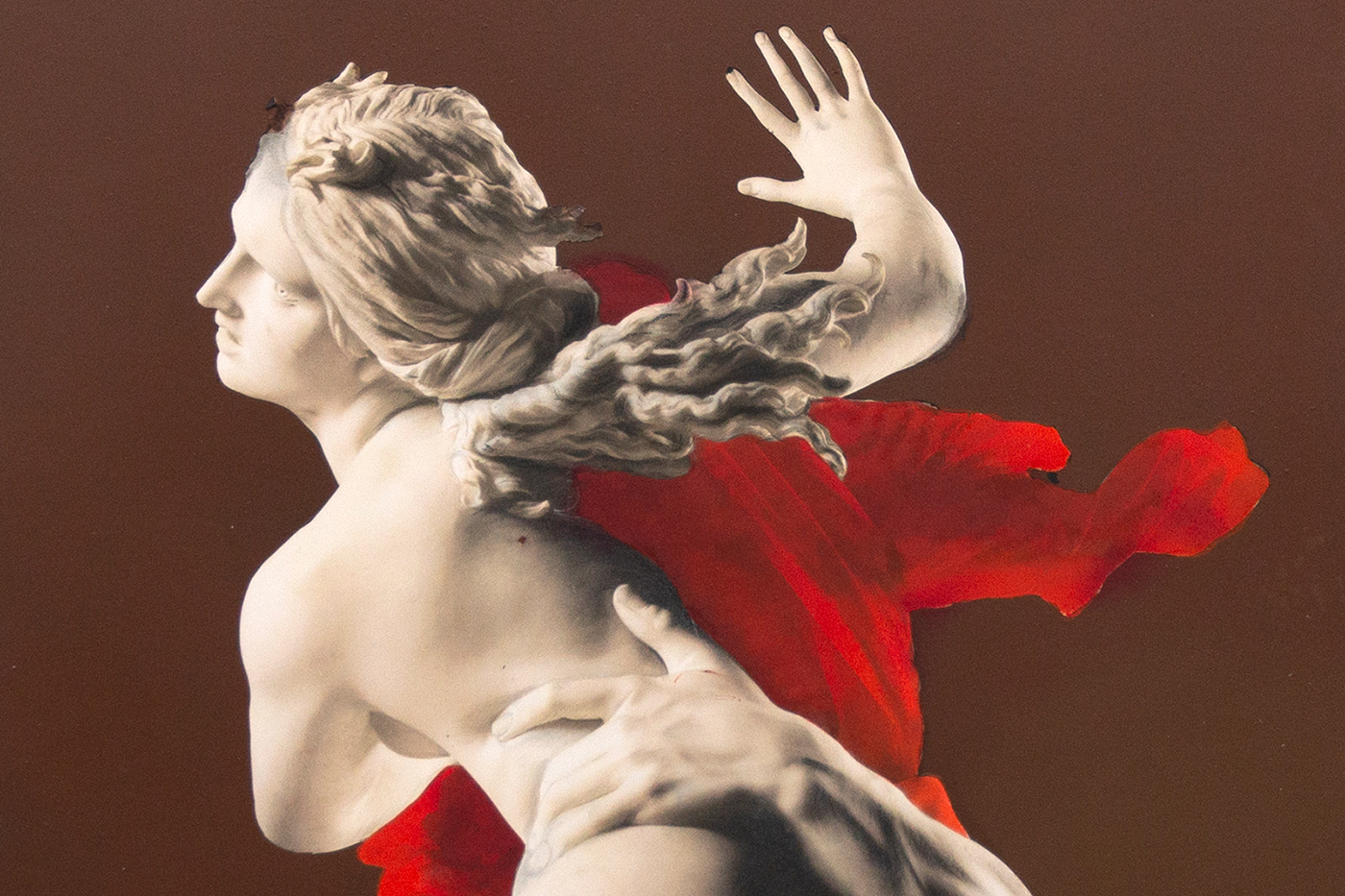
Jiménez Carrero offers us a new vision of this great character and his legend, and is able to capture that dramatic moment, although substituting the artifact created by the woodcarver and presenting an Icarus with satin and silk wings that are slightly moved by the wind with the same dynamism seen in birds. Another vision of the painter shows the anonymous face of a paradoxically well-known artist on a paper that covers the face of the artist falling into a void. With this, Carrero gives us a twist of the story and places the viewer where the protagonist lies, at the same height, observing from there, at a bird’s view, the fatal end of the sculptor. New perspectives and an innovative tale that Carrero creates for the city where the Icarus of Plasencia spent his last days.
Fernando Talaván Morín
