


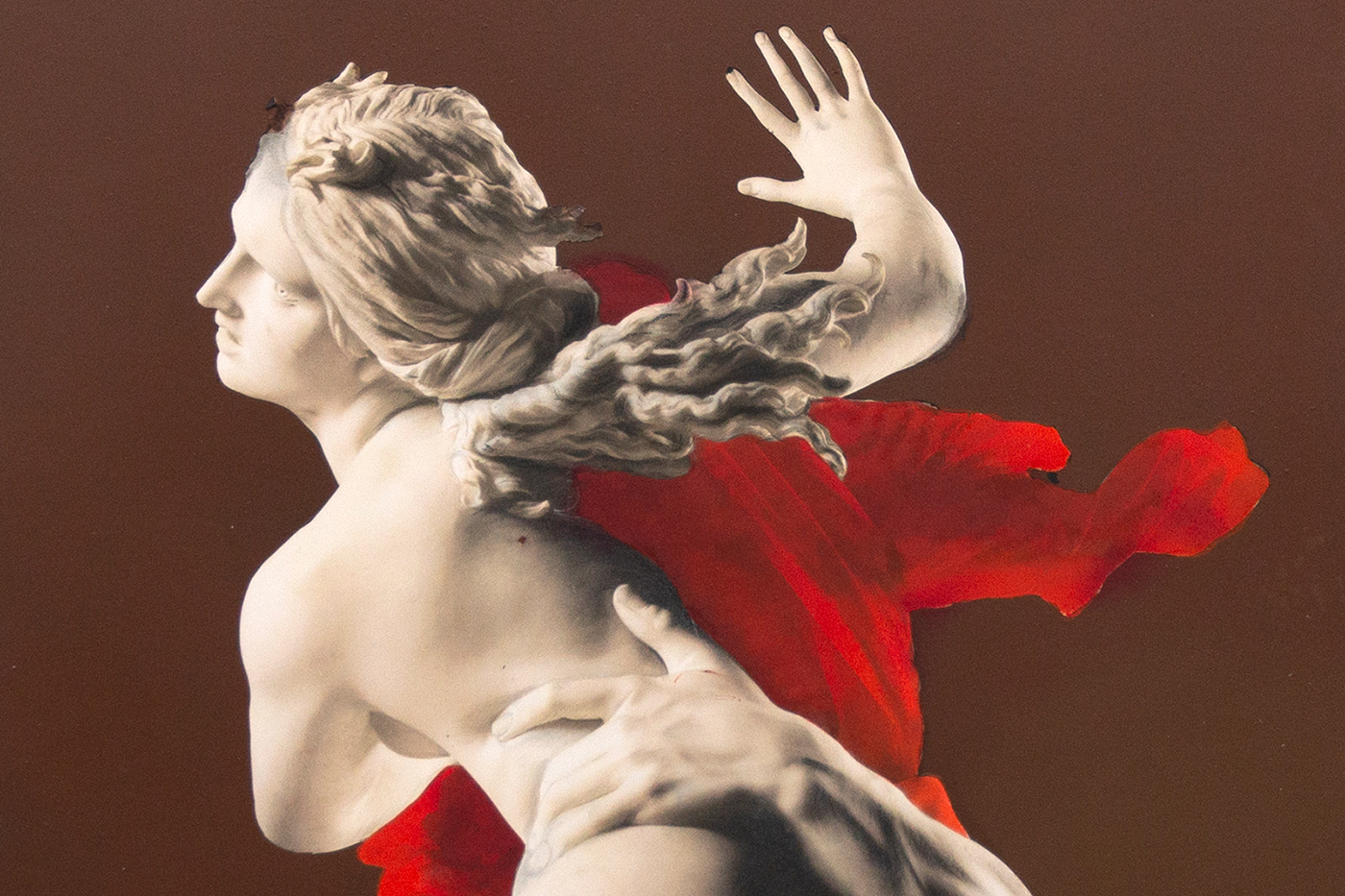
The Female Saints of Zurbarán
The paintings by Enrique Jiménez Carrero are always connected with the land that saw him come to life, in such a way that in this permanent link with Extremadura his works had to include an artistic dialogue with one of our most universal painters. And among the extensive production created by this painter from Fuente de Cantos, the series of paintings that Zurbarán created about the Female Saints is the one that has the most connections between Carrero’s discourse and the baroque master.
This is one of the most gripping pictorial repertoires of the 17th century, where Zurbarán establishes the configuration of a new stereotype to move the devotion by reflecting sanctity through a seductive machinery that stimulate prayer, but also a likeness for contemplation.
In this way, both painters constitute a path between the sacred and idealized image and the earthly and profane vision. They represent a humanized sanctity, close to the people, impregnated in ordinariness. In both cases these are female portraits from the two time periods when the two painters lived, with anachronistic garments, where theatricality and beauty matter more than the historic accuracy of the characters. A reflection of the Spanish fashion of that period, sometimes a bit more courtesan and others more popular, where the fabrics, colors, stitching, cloths, creases and ornaments create an ornamentation that moves between simplicity and wealth.
Carrero presents a Saint Casilda that is kind and benevolent, the person that took care and fed Christian prisoners, whose bread was miraculously transformed into flowers so she would not be detected. He also presents a unique and sophisticated Saint Catalina of Alexandria, with royal blood and philosophical knowledge, who carries the sword of her torment. And a Saint Barbara that, secluded in a tower, implores the heavens with the gospels in her hands to ask for salvation. Virgins and martyrs that represented the Christian exemplarity and whose iconography was rebuilt by Zurbarán and once again, reinvented by Jiménez Carrero, without forgetting his essential elements, like the use of the color white, the light or the baroque expressiveness, but still contributing once again his personal identification codes.
Fernando Talaván Morín
